Final 1031 exchanges Post

edy-cartoon-business-woman-tutorials1
The 3-Property Rule – You can identify up to three potential replacement properties without regard to fair market values of the properties.

The 200 Percent Rule – You may identify any number of properties as long as their fair market value does not exceed 200 percent of the total fair market value of all Relinquished Property (ies).

Section 1031 requires that you purchase one or more new properties by the 180th day after the closing of the old property. You must purchase one or more properties on your 45-day identification list.

This is a very simplistic break-down of 1031 exchanges, but will help you to understand the basics and to understand if a 1031 is right for you.

Basics of a 1031 Continued

imagesE8YPHIQT
To meet the requirements of §1031, both Relinquished Property and Replacement Property must qualify. In other words, both the property you are selling and the property you are buying must be qualified property of like-kind. If not, your exchange will fail and be classified as a sale.
The Internal Revenue Code requires that you identify your potential replacement properties within 45 days of the closing on the sale of your relinquished property. The 45 days are calendar days, so if the 45th day is Sunday, Labor Day or the 4th of July, that day is still the deadline for identification of new properties. There are no extensions allowed.
Basics of a 1031 Continued Will Continue tomorrow.

Basics of a 1031

gg61049176
I have been working on 1031 exchanges for many years. Here are the basics of a 1031-

The key advantage of a Section 1031 exchange is the ability to sell a property without paying any capital gain tax, or depreciation recapture at closing, which allows the earning power of the deferred taxes to work for the benefit of the investor.

Although Section 1031 refers to “an exchange of property”, it does not require a simultaneous “swap” of properties. A Qualified Intermediary “QI” is an entity who enters into a written agreement with the taxpayer (“exchanger”) to acquire the exchanger’s rights and/or ownership interest in the property the exchanger is selling (“relinquished property”), and transfer such ownership interest into one or more properties of “like-kind” that the exchanger chooses to buy (“replacement property”). A QI is required by tax law and provides a safe harbor for the taxpayer (exchanger). I use Custom 1031 in Spokane as the QI for almost all 1031 exchanges that go through my office.

In other words, the intermediary is “assigned in” as the seller of the property during the closing process. It is the assignment that allows the seller to become an exchanger and, essentially convert an otherwise taxable sale and subsequent purchase of investment real estate into a tax-deferred exchange.

Because the intermediary is technically the seller who receives the sale proceeds, it prevents the exchanger from being in “actual or constructive receipt” of the proceeds; thus, there is nothing to tax.

This Post will be Continued tomorrow.

Agriculture and Water Quality Advisory Committee

The first meeting for the Agriculture and Water Quality Advisory Committee with co-chairs Vic Stokes and Maia Bellon was March 19, 2014. The meeting was held at the DOE offices in Lacey, WA. There were 17 organizations present by representatives and many of the secondary representatives were also present in the audience. The audience was packed with interested parties who were only allowed limited interaction. I was there as the WCA Representative.
DOE also set up a link on their website for people to follow what is going on with the meetings and to know who attends as the representatives. Here is the link to that website:
I have a full article detailing what happened at the meeting coming out in the Ketch Pen.
images

Ranchers worried about ruling on waste control

Tyler Tjomsland photoBuy this phot

Tyler Tjomsland photoBuy this phot

Bill Demers is a small-time rancher, grazing three cows on 65 acres of rolling pasture in south Spokane County.

It’s a job the retired juvenile court officer relishes. Demers’ cows – Sophie, Ginger Snap and Pistol Annie – trailed him as he drove a small tractor over the land this week, pointing out improvements that he’s made since moving there six years ago.

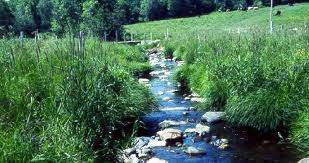
A healthy layer of sod grows on formerly bare ground adjacent to the North Fork of Stevens Creek. Demers re-established the grass cover by keeping his cows out of the intermittently flowing creek when there’s water in it. But he fears that state water quality requirements eventually will force him to fence off the creek, which he said would cost about $12,000 for a farming operation that nets $1,500 or less each year.

“It would put me out of business,” Demers said.

Fencing and water have always been hot topics in the rural West, and Friday was no different as 100 ranchers met to talk about how a recent state Supreme Court ruling might affect their livelihoods.

In the case involving Dayton rancher Joseph Lemire, the state’s high court affirmed the Washington Department of Ecology’s authority to regulate livestock pollution in streams.

The agency had ordered Lemire to put up fencing to keep his cows from trampling the banks of Pataha Creek and keep manure out of the water. The August court ruling also said the plaintiffs didn’t demonstrate that the fencing requirement qualified as a “taking” of private property.

“For landowners, this is a very big deal,” said Hal Meenach, president of the Spokane County Farm Bureau. “Areas close to waterways are the best pasture that a cattleman has. If they lose it, it’s a huge loss in the number of cattle that their land can support. With the Lemire ruling, it’s not considered a taking.”

Ranchers said they’re worried that the ruling will lead to aggressive enforcement.

Since the ruling, the Ecology Department has sent out “a wave” of letters to ranchers, telling them their cows are polluting streams, said Toni Meecham, president of the nonprofit Washington Agriculture Legal Foundation, who represented Lemire.

However, “this is nothing new that Ecology has this authority,” said Rachael Paschal Osborn, a water attorney and adjunct professor at Gonzaga University’s law school.

She said the ruling affirmed the state’s broad authority to regulate discharge into streams, including pollution sources such as cattle.

“Water is a public resource,” Osborn said. “Cows in streams can be very damaging to the ecology.” Taking the position that livestock should be allowed in creek bottoms regardless of impact isn’t reasonable, she said.

The Department of Ecology has been working to reduce livestock’s effect on streams for about 12 years, said Chad Atkins, a water quality specialist for the agency.

When livestock operations aren’t managed properly, they’re a source of coliform bacteria, excess nutrients and sediment in waterways, he said. They can also alter water temperature and pH.

Ecology officials look for visual evidence that livestock are affecting streams, such as bare ground, eroded banks, manure piles and extended livestock access to the water.

But Atkins said it’s rare for the state to take regulatory action against a livestock operator. Usually, the department’s employees and ranchers can work together to find solutions, he said.

“Good water quality and a healthy livestock industry aren’t mutually exclusive. You can have both,” Atkins said.

The regulatory action against Lemire came after years of inaction by the rancher, whose practices had been identified 10 years ago for having negative effects on Pataha Creek’s water quality.

State and federal programs can help ranchers pay for fencing and sources for watering cattle away from streams, Atkins said. But if ranchers take the money, they have to agree to leave buffers of streamside vegetation that cows can’t access.

Beginning in July, one grant program will require 75-foot buffers around salmon-bearing streams.

Osborn, the water attorney, said she wouldn’t be surprised to see legislative proposals next year to weaken the Ecology Department’s ability to regulate water pollution from cow pastures.

That’s indeed in the works, said Meecham, the attorney hired by Lemire. Fundraising is also underway to hire an Oregon State University range specialist, who would be available to consult with ranchers who are told their operations are harming water quality, she said.

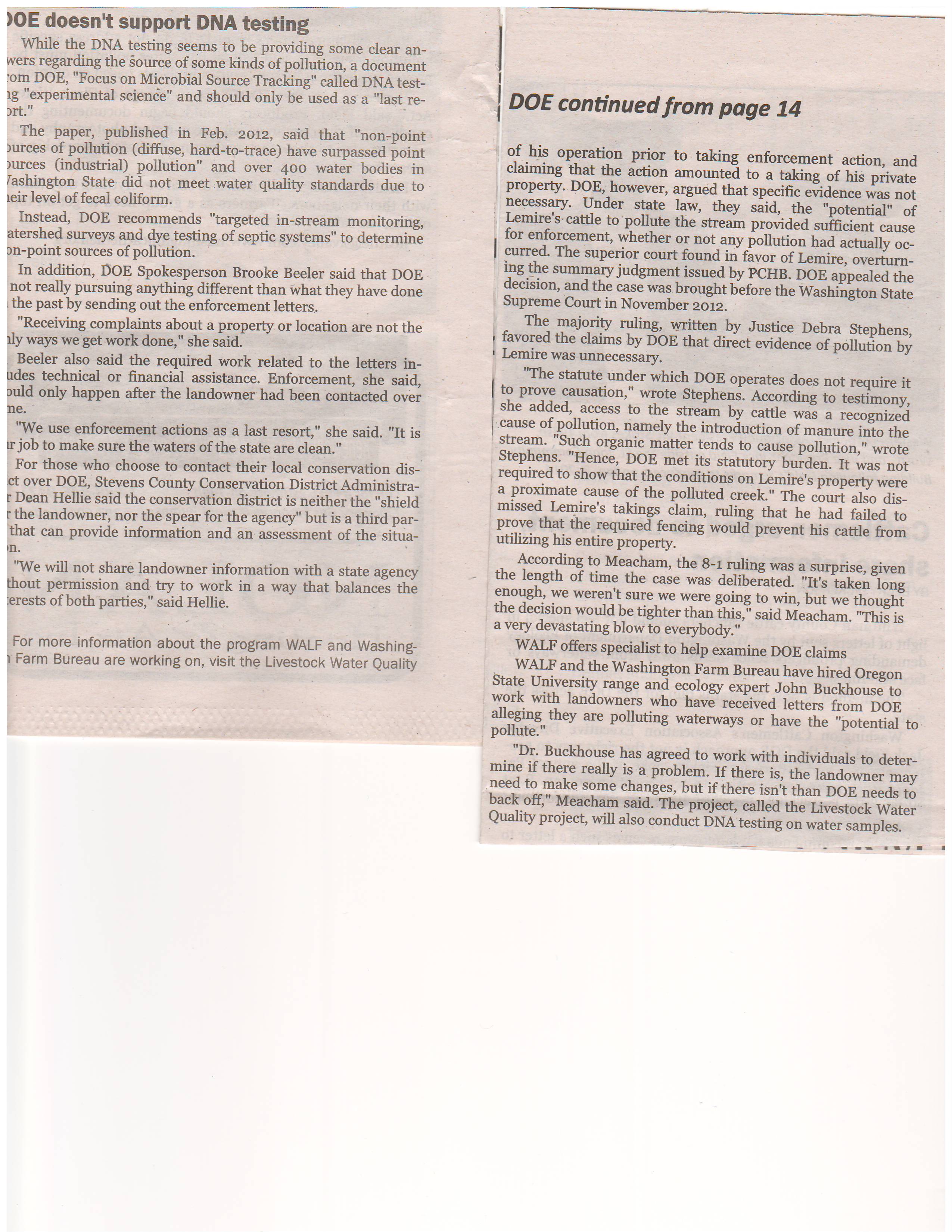
In addition, ranchers want DNA testing of coliform bacteria, to indicate whether it’s coming from livestock or wildlife, Meecham said. Fencing cattle out of creeks increases habitat for rodents and birds, which can actually increase coliform bacteria levels, she said.

Demers, the rancher with three cows who organized the Spokane County Cattlemen’s Association meeting, isn’t sure where all this leaves him.

He’s in the Hangman Creek watershed, which has high levels of coliform bacteria and sediment in the water.

Six other livestock owners in the Hangman watershed have received notices from the Department of Ecology, saying that their practices are hurting water quality. Demers said he expects to get a notice, too.

And yet Demers, a 4-H instructor, said he’s a good caretaker of the land. He’s hauled junk vehicles out of the creek, along with old lumber and other debris. During the seasons when cows have access to the dry creek bed, he uses a hand shovel to remove the cow pies. The manure is stashed where the runoff won’t reach the creek, he said.

Each patch of ground is familiar to Demers, who recites the history of his efforts to get forage grass re-established there. He’s protective of the turf that keeps erosion from running into the creek. That’s something most ranchers share, Demers said.

“We’re grass farmers first,” he said.

At issue

• The ruling:                The state Supreme Court affirmed the Washington Department of Ecology’s authority to regulate livestock pollution in streams.

• The reaction:                Ranchers are worried the ruling will lead to aggressive enforcement, including costly fencing requirement

More about me.

I am also the executive director of the Washington Agriculture Legal Foundation were I strive to help the ranchers and farmers protect their land and livelihoods. As well as, a member of the; Washington Bar Association, Benton-Franklin Bar, Benton-Franklin Young Lawyers Bar,  American Quarter Horse Association, American Angus Association, American Hereford Association, United Braford Breeders, Washington Cattlemen’s Association, Franklin County Cattlemen’s Association and the Nation Foundation Quarter Horse association. I served as a director for the United Braford Breeders. I am a sponsor of the Franklin County Cattlemen’s and the Cattle Producers of Washington. I enjoy being an active member of the community and helping fellow farmers and ranchers.

Toni

President of Advising Generations

I had the opportunity to meet with Dave Spetch, who is an advisor for generation based family businesses and President of Advising Generations, LLC. Dave has moved to the Columbia Basin and is a great asset for those family based businesses that need extra help in planning beyond the attorney and CPA. Dave has been published in Successful Farming magazine and has spoken at the NCBA meeting. For more on Dave go to davespecht.com

DSlogo

2012 census

royalty-free-businesswoman-clipart-illustration-1107095
Most people know that the 2012 census is out, here are some of the fun facts according to the Washington State Dairy Federation: 2012 Census of Agriculture
The below is a first glance analysis of some of the key data points for Washington state.    In WA, land in farms declined by 224,000 acres to 14,748,120 acres, a decline of 1.5% from 2007.  … The average WA farm size grew by 15 acres to 396 acres. WA farm numbers show a 5% decline since 2007, down 2,035 to 37,249 in 2012.  The number of 1-9 acre WA farms increased 14% to 10,559 and now makes up nearly 30% of all farms.
Farms 10 to over 1000 acres all saw declines. WA farms in the 500-999 acre category saw the biggest decline (down almost 13%) to 1,508 farms.  The market value of WA agricultural products sold grew by nearly 35% to over $9 billion.
WA farms in the economic class of $1,000,000 or more grew by 344 farms, the only increase in economic class numbers. WA farming as a primary occupation declined by 2%
WA farmers under 25 grew by nearly 25% to 181. This age category makes up half a percent of all farmers in WA. WA farmers 25-64 all saw declines, while farmers 65 and older grew.
WA Latino origin famers saw an increase of 14% to 1,874 farmers. This demographic now represents 5% of all farmers, up from 4% in 2007.
The average age of WA farmers increased from 57 in 2007 to 58.8 in 2012.

Wills and Estate Planning

Estate planning is for everyone. While most people do not like to think about death, it is a reality and typically unplanned. It is a lot easier on everyone, especially if you have a spouse, children and/or any relatives, if you draw up your own will and testament. I have been posted lots of information on estate planning, they should answer most of your questions. When you are ready to plan your estate give me a call and we will get started.

Estate Plannin3